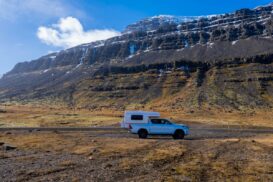
The Remarkables, Queenstown
Queenstown is considered by many sportsmen as the capital of extreme sports and adventure activities. It is situated in Otago region, in the South Island, New Zealand.
Home > MOUNTAIN SPORTS > Mountaineering > Broad Peak (K3), Karakoram Park
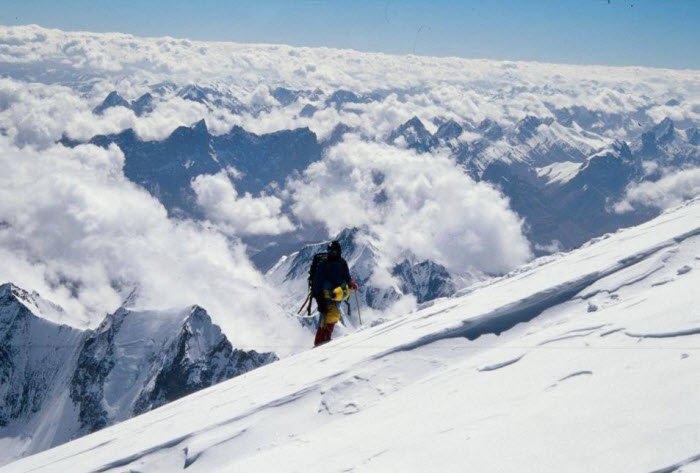
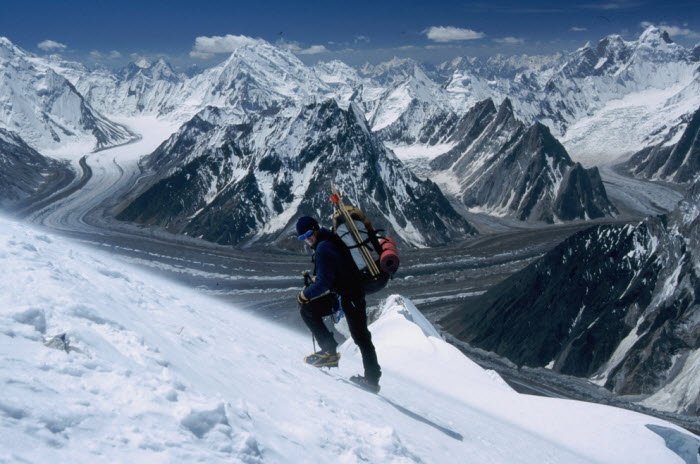
Broad Peaks location, along the western Baltoro glacier between Gasherbrum IV and K2, makes it attractive to mountaineers from all over the world who wish to climb this notorious peak.
Broad Peak has three separate summits, the main summit at 8047 m/26400 ft high, the central summit at 8016 m/26299 ft high and the north summit at 7550 m/24770 ft high.
The first ascent on the main summit took place in 1957 by a four only members Austrian expedition. By using the fixed lines, set up by a German expedition back in 1954, all four expenditioners summited without using oxygen. The central summit or Broad Peak middle was first climbed by a 5 members Polish expedition in 1975. During the descent, 3 of them have died.
The north summit was first climbed in 1983 by an Italian expedition. Since 1957 until 2003, the mountain has been climbed 255 times and counts 18 deaths. Statistically, it is one of the safest 8000 m/26246 ft high peaks, given that death percentage is dropping down at 7%.
Today, many teams use the moderate climbing of the Broad Peak in order to acclimatize themselves for a rapid alpine style ascent of the K2. The main route via the west ridge is moderately strenuous but like every other mountain in the Karakoram range, weather is often the determining factor. Only five people have climbed twice Broad Peak and no one more than that.
Broad Peak is one of the mountains where many stop at the fore-summit, never reach the actual summit and claim to have climbed Broad Peak.
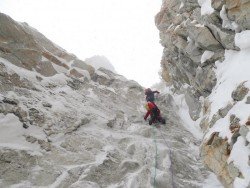
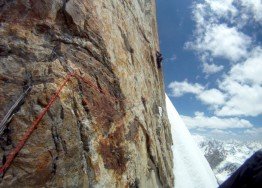
A short route overview reveals 4 possible routes: the Standard route on the west ridge, the Carsolio Route on the west ridge to south face, the Long Summit Ridge Traverse and the South Face Ridge. Pick up one route with the local school guides assisstance and have the time of your life by mountaineering on the Broad Peak.

Queenstown is considered by many sportsmen as the capital of extreme sports and adventure activities. It is situated in Otago region, in the South Island, New Zealand.
Laila Peak is a mountain, situated in Hushe Valley near the Gondogoro Glacier which belongs to the Karakoram range in Pakistan. Its spear shape is very distinctive and it sets out from other mountains in the area. At its northwest face lies a slope of 45 degrees in more than 1500 vertical m/4921 ft high.
Gasherbrum is a pretty remote group of peaks, situated at the northeastern end of the Baltoro Glacier and placed in the Karakoram range of the Himalayas, on the border of the Gilgit - Baltistan controlled by Pakistan and the Chinese-administrated Shaksgam Valley. This massif contains three of the 8000 m/26246 ft high peaks of the world.
Glenorchy is a small settlement, situated in Otago region, in the South Island of New Zealand. It lies on the northern side of Lake Wakatipu and is surrounded by Richardson and Humboltd Ranges.
Mount Elbrus or Adyge 'Waschhemaxwe' or Karachay-Balkar is a dormant volcano situated in the western Caucasus mountain range, in the Republics of Karachayevo-Cherkesiya and Kabardino-Balkariya, Russia, near the Georgian borders.
Glen Coe is one of the most famous Scottish glens in the Highlands. In the heart of Glen Coe, a small village named also Glencoe is located. Surrounded by mountains, this place is perfect for those who love mountaineering. The peak of Buachaille Etive Mor (Stob Dearg) is a 'must do'.
Latok is a small cluster of dramatic rock peaks, belonging to the Panmah Muztagh and being a part of the central Karakoram range in Pakistan. The cluster lies in the east of the Ogre group which is dominated by Baintha Brakk.
Gasherbrum is a pretty remote group of peaks, situated at the northeastern end of the Baltoro Glacier and placed in the Karakoram range of the Himalayas, on the border of the Gilgit - Baltistan controlled by Pakistan and the Chinese-administrated Shaksgam Valley. This massif contains three of the 8000 m/26246 ft high peaks of the world.
Muztagh Ata, also known as Muztaghata, is the second highest mountain of the range, forming the northern edge of the Tibetan Plateau. Its name literally means “ice-father-mountain” and is one great mountaineering destination.
Khridas is a valley, situated in between the Charakhusa and Nagma Valleys, offering many peaks of various elevations for one of the most popular mountain sport, rock climbing.
Gasherbrum is a pretty remote group of peaks, situated at the northeastern end of the Baltoro Glacier and placed in the Karakoram range of the Himalayas, on the border of the Gilgit - Baltistan controlled by Pakistan and the Chinese-administrated Shaksgam Valley. This massif contains three of the 8000 m/26246 ft high peaks of the world.
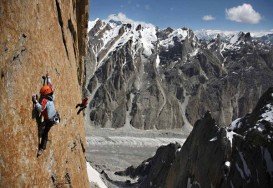
The Trango Towers is a group of tall, large and dramatic granite spikes, situated in the north side of the Baltoro Galcier, in Baltistan, northern Pakistan. The rocks are a part of the Baltoro Muztagh which is a sub range of the Karakoram. The group offers some of the largest cliffs and some of the most challenging rock climbing opportunities in the world.
Khane Valley is situated in the Karakoram range of Pakistan. The valley has to offer many peaks, unclimbed and unknown steep Big Wall ascents, perfectly suitable for rock climbing enthusiasts.
Spantik, also known as Golden Peak, is a mountain that belongs in Spantik-Sosbun Mountain which is a subrange of Karakoram mountain, situated in Nagar Valley, Pakistan. The peak lies at northeast of Malubiting and east of Diran.