Paragliding in Sir Lowry’s Pass, False Bay,
Western Cape South Africa
Launch:
320-420m/1050-1378ft
Wind Factor:
15-20Knots
False Bay is a body of water characterized by Cape Hangklip and Cape Peninsula, located in the southwest of South Africa. The bay is 30 km/18.7 mi wide, offering a Mediterranean climate with warm, dry summers and wet damp winters. The east and western shores of the bay are rocky and mountainous with visible peaks rising from the waters, while the northern side comprises a long, curving beach.
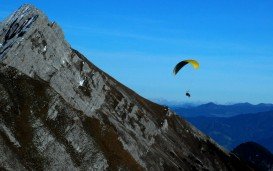
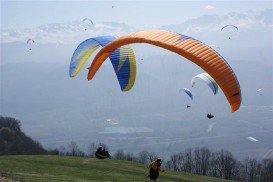
Sir Lowry’s Pass offers para-glider an amazing experience. The spot offers soaring and cross-country with breathtaking views of Gordon Bay across False Bay.The long mountain chain extends consistently to the south. Launch altitude stands at 320-420 m/1050-1378 ft above sea level and level of difficulty is graded as basic.
Predominant winds are from the southwest and west with wind strengths at 15-20 knots. Flight ceiling on the other hand lies between 1200-2000 m/3937-6561 ft above sea level.
Wilderness is a resort, lying between the Outeniqua mountains and beautiful warm waters of the Indian Ocean. Rich with beautiful beaches and a number of rivers and lakes, Wilderness offers considerable amount of tranquility making it a perfect beach holiday spot. Climate is warm all year round with winters offering sunny and warm days.
Innsbruck is situated in the western Austria, on the broad valley right among high mountains (Hafelekar in the north, Patscherkofel and Serles in the south) and half way between Munich (Germany) and Verona (Italy). It is the capital city of the federal state of Tyrol in the Inn Valley on the joint with the Wipptal (Sill River) that provides admission to Brenner Pass, at approximately 30 km / 18.6 mi in the south of Innsbruck.
Cuba nestles at the crossroads of the Caribbean. Whether you are a nature lover or a culture vulture, it is certain that Cuba will enchant you with its unparalleled beauty. Havana is the capital city of Cuba and the largest one in the Caribbean with many places of historical interest, including castles, museums and cathedrals. The climate here is classified as tropical, with an average temperature of 69.8 °F/21 °C in winter and 80.6 °F/27 °C in summer.
Grenoble is the capital of the Isère department. It is situated in the Rhone-Alps region in southeastern France where the river Drac joins the Isère, right on the foot of the French Alps. Grenoble has a rich history to demonstrate, going back for more than 2.000 years when it was just a small Gallic village. Now it is a big industrial and scientific center in Europe. However, Grenoble is a big sporting center where many extreme sports are being performed.
Already since the '70s, Cortina d' Ampezzo was considered to be the most important flying area in Italy and Europe as well. The Italian Free Flight Federation was also founded here in 1976 when many clubs have started to operate many free flights at the same period.
The Overberg is a region of immense beauty and characterized by amazing and diverse landscapes. It forms part of the Western Cape as it stretches from the Hottentos-Holland Mountains in the north while in the southern, the Atlantic and Indian Ocean break on to sandy beaches and rocky headlands. The spot enjoys a Mediterranean climate with warm dry summers and cool wet winters.
The Hottentots Holland mountain range is part of the Cape Fold Belt in the Western Cape, South Africa. The range forms a barrier between the Cape Town metropolitan area and the southern Overberg coast.
Langebaan Lagoon is situated at 120 km/74 mi north of Cape Town and stretches at 20 km/12 mi in length and 4 km/2.5 mi wide. Unlike other lagoons, Langebaan is pure salty water. The white sandy beaches and crystal clear waters are just breathtaking whether it is sunny or cloudy.
Without doubt, Cape Town is one of the most beautiful cities in the world, boasting striking mountains, a long stretch of the Atlantic Ocean coastline and an intriguing working harbour. Located at the shores of Table Bay in the Western Cape province of South Africa, it enjoys an ocean Mediterranean climate with mild moderately wet winters and dry warm summers.
Without doubt, Cape Town is one of the most beautiful cities in the world, boasting striking mountains, a long stretch of the Atlantic Ocean coastline and an intriguing working harbour. Located at the shores of Table Bay in the Western Cape province of South Africa, it enjoys an ocean Mediterranean climate with mild moderately wet winters and dry warm summers.
The Overberg is a region of immense beauty and characterized by amazing and diverse landscapes. It forms part of the Western Cape as it stretches from the Hottentos-Holland Mountains in the north while in the southern, the Atlantic and Indian Ocean break on to sandy beaches and rocky headlands. The spot enjoys a Mediterranean climate with warm dry summers and cool wet winters.
Without doubt, Cape Town is one of the most beautiful cities in the world, boasting striking mountains, a long stretch of the Atlantic Ocean coastline and an intriguing working harbour. Located at the shores of Table Bay in the Western Cape province of South Africa, it enjoys an ocean Mediterranean climate with mild moderately wet winters and dry warm summers.
Langebaan Lagoon is situated at 120 km/74 mi in the north of Cape Town and stretches at 20 km/12 mi in length and 1.5 km/0.9 mi in width. Unlike other lagoons, Langebaan is pure salty water. The white sandy beaches and crystal clear waters are just breathtaking whether it is sunny or cloudy.
Without doubt, Cape Town is one of the most beautiful cities in the world, boasting striking mountains, a long stretch of the Atlantic Ocean coastline and an intriguing working harbour. Located at the shores of Table Bay in the Western Cape province of South Africa, it enjoys an ocean Mediterranean climate with mild moderately wet winters and dry warm summers.